

Can GenAI Design Like Jony Ive? Here Is A Surprising Update…Product Design Is On Notice!
A year ago, the research team at Mauro Usability Science published a widely circulated article asking the seemingly ridiculous question, “Can A GenAI Design Like Jony Ive?” In our study, we used simple prompt progressions fed into the most robust GenAI at the time, asking it to design a simple consumer product (a toaster) using the design theory and visual design vocabulary of Jony Ive. I note that we did not tell the GenAI anything about Jony Ive or his work.
The answer to our initial question was yes, GenAI could, without any background support, produce surprisingly robust simple consumer product design concepts in the style of Jony Ive. However, there were several massive shortcomings. Most important was the design solutions provided by the GenAI did not appear to link the visual style of the product to actual user interaction features and functions. The layout and function of task-specific controls and displays lacked any connection to simple functional operation.
Specifically, the controls and displays on the products provided were nonsensical or lacked functional indications, such as control labels or other connections between usability and the overall visual form. We include our initial examples in the text and images that follow.
Our Updated Analysis: More than a year after the publication of our initial analysis, we felt compelled to determine whether the progression of GenAI development had resulted in improved outcomes with respect to our original research questions. So, we ran an updated study utilizing Google Nano Banana, a recently released GenAI tool. The findings were surprising.
Today, the best current GenAI produces conceptual product design solutions that have progressed far faster than we anticipated a year ago. Progress across several dimensions of product design theory and practice is now running at the heart of GenAI systems. If GenAI continues on its current positive trajectory in linking product visual design to usability through UX design, the fields of product design, UX design, and Usability Engineering are in for a massive dose of disruption. Much of traditional product design education will be rendered moot.
Recent developments in GenAI, most specifically Google’s Nano Banana release, prompted us to revisit the question “Can A GenAI Design Like Jony Ive?”. The resulting analysis is rather startling in how quickly GenAI is evolving toward a universal design tool that can and does embody the semantic structures and visual vocabulary of famous designers, which can be applied to products across broad categories. Here are our updated findings inserted into the original article.
An Interesting and Deeper Research Question: Lurking below the surface of GenAI is a far more interesting research question: When a GenAI/ML/LLM is trained on a massive dataset drawn from published text and images, to what extent does that process capture the essence of the design approach of a famous designer like Jony Ive? In other words, does an GenAI know what attributes a given product design solution should have if Jony Ive designed it? Since we know a lot about the visual design attributes of Jony Ive’s products, it offers an unusual opportunity to probe the real impact GenAI might have on Design. At the end of the day, businesses large and small want quality design solutions which designers like Jony Ive produce.
A Second Question, Collaboration in Design: As product design solutions become more complex, it has become necessary for teams of designers to collaborate. This was a second variable in our initial research. We were also interested in the question: “Can a GenAI capture design collaborations BETWEEN famous designers?” For example, what if we asked a GenAI to produce a product design solution that resulted from a collaboration between Jony Ive and Dieter Rams? If GenAI can forge links of this conceptual nature, the potential impacts on design are profound. It also demonstrates that the stochastic math underlying GenAI is doing something well beyond word-progression prediction.
The Initial and Updated Study
Data Capture: To explore these two questions, our research team created a series of carefully engineered prompts to determine if a GenAI can DESIGN like Jony Ive. We wondered whether Jony Ive’s highly subjective visual design vocabulary had somehow been linked to the Generative AI visualization system. When one thinks about it, this is a profoundly interesting question because it says that a GenAI, when trained on a large enough dataset, captures something as subjective as a famous designer’s approach to solving a visual design problem. Can it map visual design descriptions to an actual design and rendering of a product that the designer never created? That would not be good news for the world of product design or UX design!
Initial and Updated Findings: In the following examples, we explore the extent to which ChatGPT4 and Google Nano Banana create product design solutions that reflect Jony Ive’s extraordinary ability to produce simple, refined visual design solutions to everyday product design problems. Following our exploration of the Jony Ive visual design attributes, we then tasked the system with creating a toaster designed by Dieter Rams, a highly renowned designer. In the end, we also show the results for a design that flows from the collaboration of Rams and Ive.
Our first experiment over a year ago was to engineer prompts that tasked ChatGPT4 with designing an everyday product (a toaster) in the style of Jony Ive. This exercise produced rather startling results. For example, when we asked the GenAI to design a toaster in the style of Jony Ive, it created the design below.
Initial Jony Ive Design (4/2/2024)

Initial toaster design based on visual design theory and practice by Jony Ive (ChatGPT4)
Initial Findings: By any reasonable measure, the toaster above, which ChatGPT4 created in roughly 12 seconds, embodies the essential visual design attributes for which the real Jony Ive is well known, including the semantic differential characteristics of: “simple, refined, minimalist, modern, and structured“. Whether Jony Ive would accept a commission to design a toaster is irrelevant, since one can ask a GenAI to create anything based on Jony Ive’s theory and practice, regardless of Mr. Ive’s view on such a commission.
Mr. Ive’s ability to claim a measure of IP protection for such a solution is well beyond the currently available IP systems covered by design patents, utility patents, copyright, trademark, or trade dress. We are in a totally new IP territory with GenAI-produced design solutions based on the documented theory and practice of a famous designer. This is off-the-grid IP
This example demonstrates that, fundamentally, Jony Ive is in the soul of the machine. This is not totally surprising when one considers that Jony Ive has been mentioned in thousands of articles, Apple news releases, video presentations, books, interviews, and related content that OpenAI utilized to train ChatGPT4 and Google used to train Nano Banana. But parsing such content into an applicable design theory from which products can be formulated is a level beyond. In this example, it is clear that ChatGPT4 captures the visual design attributes of one of the world’s extraordinary designers and maps them onto a fully rendered product. It does so with surprising clarity and then applies these attributes to a product category that was never included in the training set…EVER!
Not only does the GenAI capture a “Jony Ive-aligned” form factor, it also renders the product in a material finish for which Mr. Ive is famous, the silver matte aluminum finish of the MacBook Pro series. The LLM design even further embodies Jony Ive’s distaste for control labels and his reliance on the device’s affordances to convey function. It took approximately five levels of prompt refinement to reach the design above.
This simple example demonstrates that a GenAI can design like Jony Ive in profoundly interesting ways. But let’s not think for a moment that such capability is generalizable to all manner of products— our research shows it is not.
Let’s now turn to how the same question is answered a year later, using Google Nano Banana. Below is the toaster design produced using the same prompt sequence from over a year ago. Again, we were focusing on the utilization of Jony Ive’s visual design theory and practice embedded in the machine.
Updated Jony Ive Design (11/24/25)

Updated toaster design based on Jony Ive visual design theory (Nano Banana)
The Jony Ive 2025 Update: In the image above, produced on Nano Banana, one can see a significant level of visual design refinement compared to the product design produced previously by ChatGPT4. It can be seen that the GenUI generated a more interesting overall shape while removing interface control elements and labeling to an even greater extent compared to the initial design. Again, this aligns with Ive’s reductionist theory, applied to product visual design simplification based on minimizing interface controls and related labeling to the maximum extent possible.
This updated product added new interface displays, including a lighted status bar and a backlit primary control. Overall, the updated design shows progress toward linking overall product shape with control and display functionality and UX design. This is a critical improvement made possible by providing fully configured product design solutions using GenAI that include usability and UX considerations. In the process of analyzing Jony Ive’s GenAI, we realized that, given his extensive exposure, he may be an aberration, providing a mapping of his design theory to a broad range of products. Is he the only designer having a soul at the heart of the machine? We then ran the same study on another famous designer, but with less massive exposure. We chose Dieter Rams. (We note the history of Rams and Ive and used this combination on purpose)
Dieter Rams On His Own: In our initial research, we used the same prompt structure and GenAI to generate design solutions inspired by Dieter Rams. Again, we did not feed the GenAI any content on Rams. Overall, the solutions were embarrassing versions of the Dieter Rams real-world products. For example, the toaster designed by the GenAI using only Dieter Rams in the prompt is shown below. Interestingly, the GenAI training set captured the segmented shapes and control layout concepts from Dieter Rams’ real-world designs. But the system stitches these attributes together in such a way that makes no functional or visual design sense.
The differences between the Jony Ive toaster and the one below based on Dieter Rams may be attributable to the vast amount of content that Jony Ive has in the training set compared to that of Dieter Rams. However, Dieter Rams also has thousands of pages dedicated to his work. Yet, his toaster is a palette of unrelated buttons and dials from his Braun turntable stitched onto a complex toaster form factor. Clearly, the way GenAI produced the Rams design concept lacks the highly refined and directly relevant set of visual design attributes for which Rams is famous.
Initial Dieter Rams Design (4/2/2024)
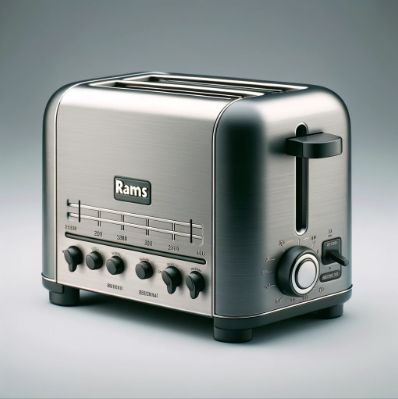
Initial toaster design based on visual design theory and practice by Dieter Rams (ChatGPT4)
What Defines Dieter Rams’ Design Vocabulary? Somewhat surprisingly, the GenAI did pick up the defining visual design attributes of Dieter Rams’ product design solutions, which are an extreme level of graphic design refinement in the layout of simple analog controls on minimalist form factors. Here is a link to some of Rams’ actual production products.
However, when we ran the same study a year later using Nano Banana, we see the design pictured below. The updated Dieter Rams toaster does a much better job of reflecting the visual design theory and practice fostered by Rams. The solution even includes the Braun logo (without prompting). Rams designed Braun products for decades. Much like the Jony Ive updated design solution, the Dieter Rams product shown below is a significant advancement in applying Dieter Rams’s design theory and practice to a simple consumer product, utilizing the GenAI framework. It looks like a Rams product.
Updated Dieter Rams Design (11/24/25)

Updated Toaster Design based on visual design theory and practice of Dieter Rams (Nano Banana)
The Collaboration Question: An even more critical question is whether producing “profound excellence” in product design through the collaboration of design experts embedded in the machine learning algorithm works. Such a capability would fundamentally change the design profession because, in theory, it would create a new level of design impact at a reduced cost.
Fabricating a Synthetic “Super-Set” of Design Expertise: Based on the initial finding regarding Jony Ive and Dieter Rams we sought to determine objectively whether the ChatGPT4 neural net could organize famous designers into a collaborative team, thereby creating a “Super-Set” of design expertise. Specifically, we asked: “What if Jony Ive and Dieter Rams collaborated on a product design problem? What would the solution be?” It is well known that Jony Ive reveres Dieter Rams’ work and has referenced Rams’ famous 10 Design Principles in his design theory.
When is A Toaster Not A Toaster? Again, initially, we chose the ordinary toaster as the design problem space. We asked the GenAI system to design a toaster inspired by the collaboration between Jony Ive and Dieter Rams. In our initial study a year ago, one can immediately see from the image below, generated by the GenAI, that it produces a nonsensical solution festooned with buttons and controls that are clearly in the visual vocabulary of Dieter Rams’ famous Braun consumer electronics, layered on Jony Ive’s rough overall form factor. This is clearly a defective mashup of conflicting design practices.
Initial Rams + Ive Collaboration Design (4/18/24)
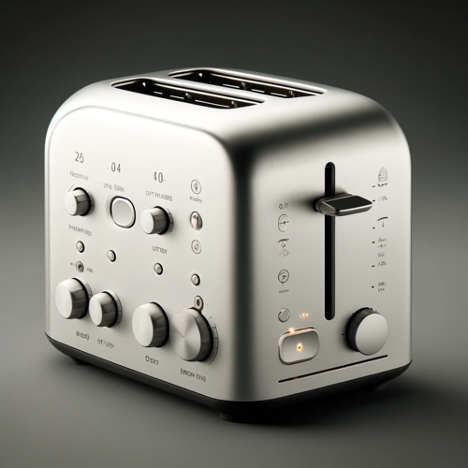
Dieter Rams + Jony Ive Design Image from ChatGPT4
The Updated Collaboration Design Solution: The image below shows the updated visual design resulting from the collaboration between Dieter Rams and Jony Ive using Nano Banana. However, in this example, we see a more cohesive collaborative design reflecting the combined visual design attributes of both famous designers. In this design solution, we see controls and displays that make functional sense, even though the actual labels are nonsensical, having random numbers and unintelligible icons. Yet the design does read overall as a synthesis of Rams and Ive with a clear integration of product design, UX design, and usability. This shows serious progress compared to the prior year.
Updated Rams + Ive Collaboration Design (11/24/25)

Updated toaster visual design combining theory and practice of Dieter Rams and Jony Ive (Nano Banana)
Which Design Would achieve the Greatest Market Success? Ultimately, market success is the goal of product design solutions. In this context, we asked the GenAI to design and execute a consumer study to determine which design would be most likely to succeed. Using synthetic consumer profiles and an approved research protocol, we asked the GenAI to run the analysis. The synthetic findings showed that the collaborative design of Rams and Ive would likely achieve the most significant market success. Collaboration produced the best solution.
Why The Collaborative Design Is Preferred: In its final reporting of the findings, the GenAI said, “The Jony Ive and Dieter Rams collaboration would likely appeal to a more pragmatic consumer and reach a wider audience. While still minimalist, the design incorporates more explicit functionality. This design marries form and function, likely attracting a consumer who appreciates clean aesthetics but also values clear, intuitive usability and a sense of timeless, durable design”. Do we believe the GenAI synthetic study? Not in a traditional research sense, but the ability to capture synthetic consumer responses will shape design research in the future? GenAI will soon provide this form of analysis rapidly and at very low cost. Will synthetic consumer testing replace robust professional user testing…no. Will such research be a workable heuristic? Almost certainly.
The Real Design Problem: Clearly, the design profession is threatened by GenAI. But the reason there are so many designers out of work is not currently due to GenAI. The oversupply of design expertise, failure to articulate the value of design in corporate settings, and poorly structured design education are of far greater concern to the design professions. These problems largely account for the current malaise in the design industry.
Using GenAI systems to enhance design is moving at warp speed. If professional practice and design education do not also accelerate change, traditional design services will be overtaken by GenAI faster than most realize. There will still be a massive need for design. However, many of the functions provided by design professionals, including critical early concept development, will be overtaken by engineers who can objectively utilize GenAI without input from professionally trained designers during some early phases of development.
Not only will GenAI change how design is executed, but it will also alter who undertakes critical design tasks. Structuring a prompt that creates a product design solution based on the theory and practice of a famous designer does not require design expertise.
What do Jony Ive and Dieter Rams think about all of this? One point is clear: the definition of what constitutes a designer’s legacy is no longer predictable. Like it or not, meaningful design theory and practice are in the soul of the machine. The future is not what it used to be!
Charles L. Mauro CHFP
President / Founder Mauro Usability Science